
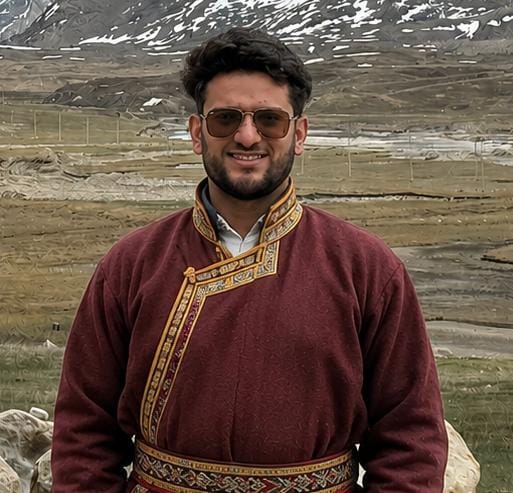
Dr. Peramjeet Singh
ASSISTANT PROFESSORAcademic Biography
Dr. Peramjeet Singh is an Assistant Professor in the Department of Physics at the Kargil Campus, University of Ladakh, India. He earned his Ph.D. in Physics from the University of Lucknow, where his doctoral research, entitled "Synthesis and Characterization of Transition Metal Oxides and Their Application as Humidity and Gas Sensors," focused on the design and development of nanostructured metal oxide materials for advanced sensing applications. His research interests encompass nanomaterials, semiconductor gas sensors, thin-film technology, carbon nanomaterials, ion beam and gamma irradiation-induced material modification, and functional materials for environmental monitoring and energy applications. Dr. Singh possesses extensive expertise in the synthesis and fabrication of advanced materials using hydrothermal, sol-gel, co-precipitation, solid-state reaction, and RF sputtering techniques. His research combines materials engineering with advanced characterization methods, including X-ray diffraction (XRD), X-ray photoelectron spectroscopy (XPS), atomic force microscopy (AFM), field emission scanning electron microscopy (FESEM), Raman spectroscopy, UV–Visible spectroscopy, and energy-dispersive X-ray spectroscopy (EDS). His work focuses on understanding structure–property relationships, defect engineering, surface modification, and the optimization of sensing performance in nanostructured metal oxides and carbon-based hybrid materials. Since joining the University of Ladakh in 2025, Dr. Singh has been actively engaged in teaching postgraduate courses, mentoring M.Sc. dissertations, supervising research trainees, and contributing to curriculum development. He also serves as the Secretary of the Board of Studies in the Department of Physics, where he plays an important role in academic planning, syllabus revision, and quality enhancement initiatives. Prior to his faculty appointment, he gained valuable research experience as a doctoral researcher in the Sensors and Materials Research Laboratory at the University of Lucknow, collaborating with leading scientists from national research institutions, including the Inter-University Accelerator Centre (IUAC), New Delhi. Dr. Singh has authored and co-authored numerous research articles in high-impact international journals, including Applied Surface Science, Applied Physics A, Materials Science in Semiconductor Processing, International Journal of Hydrogen Energy, Materials Chemistry and Physics, and Physica B. He has also contributed several book chapters published by Springer and other international publishers on nanotechnology, gas sensors, bionanocomposites, and advanced functional materials. His research has been presented at several national and international conferences, and he has delivered invited lectures on hydrogen sensing and radiation-engineered nanomaterials. His contributions have been recognized with the Best Paper Award at the International Conference on Advancements in Materials Science and Technology (iCAM-2022) and the UDDEEPAN Award from the University of Lucknow for outstanding research publications. Dr. Singh also serves as an Editorial Board Member of the Journal of Sustainable Transitions and acts as a reviewer for several reputed international journals in the fields of materials science, nanotechnology, and sensor technology. Through his research, teaching, and academic service, he remains committed to advancing innovative functional materials, fostering interdisciplinary collaborations, and mentoring the next generation of researchers in nanoscience, sensing technologies, and sustainable materials engineering.
Research focus
Hydrogen sensing using metal oxides, Structural modifications via Gamma irradiation and ion beam irradiation, Thin film deposition and characterization, Advanced materials for environmental sensing, Nanostructured metal oxide-based chemiresistors, Nanotechnology, Condensed Matter Physics, Gas sensors, Humidity sensors.
Research Publications & Papers
No Publication Selected
Select a research paper from the list on the left to preview.